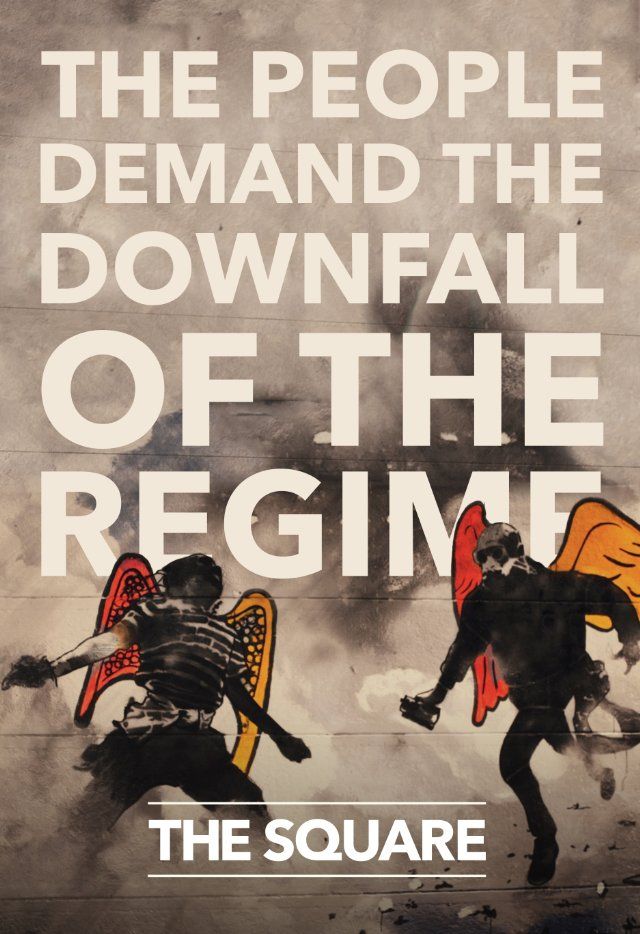
Director: Jehane Noujaim
Run time: 109 min.
Call Number: DT107.87 .S63 2015
"'The Square,' a stunning new documentary by Jehane Noujaim about the 2011 uprising in Cairo’s Tahrir Square and its aftermath, epitomizes nonfiction film not just as a way to deepen knowledge and understanding, but also as an art form. In this vibrant, lyrical, graphic, sobering and finally soaring testament to aesthetic and political expression, Noujaim consistently provides light where once there was heat."
—Ann Hornaday, Washington Post (full review here)
Showing posts with label Protest movements. Show all posts
Wednesday, August 10, 2016
Wednesday, May 25, 2016
My Stolen Revolution (2013)
Director: Nahid Persson Sarvestani
Run time: 75 min.
Call Number: DS318.839 .M97 (2013)
"A student activist in Iran's 1979 revolution that overthrew the dictatorial Shah, Nahid Persson Sarvestani fled to Sweden with her baby after Islamists seized power and began persecuting leftists who had been their revolutionary allies. Three decades later, prompted by brutal crackdowns on protests in Iran and long-suppressed guilt for abandoning a younger brother to imprisonment and death, the internationally acclaimed filmmaker locates and reunites with five women who were tortured in the jails she so narrowly escaped. . . ."
—Distributor's description
Thursday, May 12, 2016
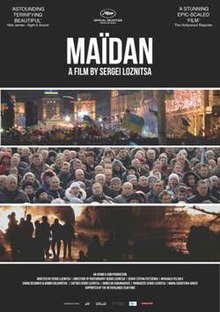
Maidan: Uprising in Ukraine (2015)
Director: Sergei Loznitsa
Run time: 127 min.
Call number: DK508.848 .M33 2015
"Easily the most rigorous, vital, and powerful movie of 2014, Sergei Loznitsa's Maidan may be a perfect Bazinian cinema-machine — reality is captured, crystallized, honored for its organic complexity, and delivered unpoisoned by exposition or emphasis. Every dissatisfaction you could be nursing about the obvious and overdetermined tenor of contemporary film — and particularly modern documentaries — is met here with thrown bricks."
—Michael Atkinson, Village Voice (full review here)
Run time: 127 min.
Call number: DK508.848 .M33 2015
"Easily the most rigorous, vital, and powerful movie of 2014, Sergei Loznitsa's Maidan may be a perfect Bazinian cinema-machine — reality is captured, crystallized, honored for its organic complexity, and delivered unpoisoned by exposition or emphasis. Every dissatisfaction you could be nursing about the obvious and overdetermined tenor of contemporary film — and particularly modern documentaries — is met here with thrown bricks."
—Michael Atkinson, Village Voice (full review here)
Tuesday, March 15, 2016
This Changes Everything (2015)
Run time: 90 min.
Call number: HC79.E5 T48 2015
"Serving as a visual companion to narrator Naomi Klein's book, this is a survey of international activism in the face of those environmental inconvenient truths. It travels from Alberta's Tar Sands to the South India site of a proposed power plant to financially strapped Halkidiki, Greece, to smog-choked Beijing. . . . Klein and those impassioned protesters provide something that has been in short supply in the predecessors — namely, a modicum of hope for the future."
—Michael Rechtshaffen, L.A. Times (full review here)
Thursday, March 5, 2015
Concerning Violence: Nine Scenes from the Anti-Imperialistic Self-Defense (2014)
Director: Göran Hugo Olsson
Run Time: 85 min.
Call Number: DT33 .F313 2004
". . . reflects the shifting focus of Swedish activist filmmakers during the mid-’70s, who grabbed their cameras and traveled to the front lines of African independence, observing firsthand the fall of apartheid and liberation of a people who’d been exploited by white Europeans for decades. . . . In searching for a mechanism to unify this incredible footage, which has gone largely unseen by the general public ever since, Olsson seized upon Fanon’s 1961 tract [The Wretched of the Earth], a controversial anarchist cookbook which analyzed the psychology of occupation and identified violent upheaval as the only means to overthrow colonialism — a system Fanon referred to as 'violence in its
natural state.'"
—Peter Debruge, Variety
Run Time: 85 min.
Call Number: DT33 .F313 2004
". . . reflects the shifting focus of Swedish activist filmmakers during the mid-’70s, who grabbed their cameras and traveled to the front lines of African independence, observing firsthand the fall of apartheid and liberation of a people who’d been exploited by white Europeans for decades. . . . In searching for a mechanism to unify this incredible footage, which has gone largely unseen by the general public ever since, Olsson seized upon Fanon’s 1961 tract [The Wretched of the Earth], a controversial anarchist cookbook which analyzed the psychology of occupation and identified violent upheaval as the only means to overthrow colonialism — a system Fanon referred to as 'violence in its
natural state.'"
—Peter Debruge, Variety
Wednesday, August 20, 2014
The Trials Of Muhammad Ali (2013)
Run Time: 94 min.
Call Number: GV1132.A45 T75 2013
Ali's life has been recounted so many times that you'd think no one could come up with a fresh angle on it; documentary maker Bill Siegel (The Weather Underground) succeeds, primarily by delving into the religious story, largely downplayed by the mainstream, that's been sitting there in plain sight for 50 years. Siegel mostly dispenses with the fighter's comic pronouncements, his verbal jousting with Howard Cosell, in fact his entire athletic career, choosing instead to explore his great political awakening in the Nation of Islam. "I know the real God!" shouts 22-year-old Cassius Clay after beating Sonny Liston in 1963, and the statement defines him for the rest of the decade as he becomes a vocal advocate of black nationalism and sacrifices his heavyweight title to protest the racism of the Vietnam war."
—J.R. Jones, Chicago Reader
Tuesday, August 12, 2014
Let the Fire Burn (2013)
Director: Jason Osder
Run Time: 95 min.
Call Number: F158.9.N4 L48 2013
"Documentaries don’t come more sparse or more disturbing than 'Let the Fire Burn,' Jason Osder’s examination of the disastrous confrontation between the police and the radical group MOVE in Philadelphia in May 1985. . . . [The film] uses archival footage from sources that include newscasts and community hearings to tell the story of the growing tension between the group and the city, which came to a head on May 13 of that year with tear gas, gunfire and the bombing of the MOVE compound from a police helicopter. The resulting fire destroyed some 60 homes. By the time it was over, 11 people were dead."
Run Time: 95 min.
Call Number: F158.9.N4 L48 2013
"Documentaries don’t come more sparse or more disturbing than 'Let the Fire Burn,' Jason Osder’s examination of the disastrous confrontation between the police and the radical group MOVE in Philadelphia in May 1985. . . . [The film] uses archival footage from sources that include newscasts and community hearings to tell the story of the growing tension between the group and the city, which came to a head on May 13 of that year with tear gas, gunfire and the bombing of the MOVE compound from a police helicopter. The resulting fire destroyed some 60 homes. By the time it was over, 11 people were dead."
—Neil Genzlinger, New York Times
Wednesday, May 7, 2014
Inventing Our Life: The Kibbutz Experiment (2012)
Run Time: 89 min.
Call Number: HX742.2 .I58 2012
"In 1910 a dozen young Eastern European Jews
moved to the Jordan Valley, then under Ottoman rule, and began to build
an agrarian community based on a utopian socialist vision. Men and women
were treated equally, everyone shared all they had, and no one had more
than anyone else.
That collective, called Degania,
was a kibbutz, the first of a communal movement that symbolized
aspirations for a Jewish homeland and became, after Israel’s statehood,
an influential force that eventually was overwhelmed by the capitalistic
society that it had helped to foster.
As 'Inventing Our Life: The Kibbutz Experiment,'
an engrossing documentary by Toby Perl Freilich, shows, the kibbutz
movement, now more than 100 years old, has been under constant siege of
one form or another. The film meshes interviews with first-, second- and
third-generation kibbutzniks— including those from Sasa,
the first kibbutz founded by Americans—and commentary from Israeli
scholars with tours of numerous kibbutzim today and vintage footage from
as far back as the 1920s."
—Daniel M. Gold, New York Times
Thursday, April 10, 2014
Bidder 70 (2013)
Director: Beth Gage & George Gage
Run Time: 73 min.
Call Number: QH77.3.C57 B53 2012
"Bidder 70 tells a uniquely American story. Only in the United States would the president auction off protected wilderness to energy and mining companies to help the government turn a profit. Only in the U.S. would a college student show up to the auction and outbid the companies, then be taken to court and ultimately thrown in federal prison for falsifying his bids. That president was George W. Bush, of course. The wilderness was in Utah. And the college kid, Tim DeChristopher, proves a fascinating subject for Beth and George Gage's new documentary."
—Diana Clarke, The Village Voice
Run Time: 73 min.
Call Number: QH77.3.C57 B53 2012
"Bidder 70 tells a uniquely American story. Only in the United States would the president auction off protected wilderness to energy and mining companies to help the government turn a profit. Only in the U.S. would a college student show up to the auction and outbid the companies, then be taken to court and ultimately thrown in federal prison for falsifying his bids. That president was George W. Bush, of course. The wilderness was in Utah. And the college kid, Tim DeChristopher, proves a fascinating subject for Beth and George Gage's new documentary."
—Diana Clarke, The Village Voice
Monday, April 7, 2014
Mumia: Long Distance Revolutionary (2013)
Director: Stephen Vittoria
Run Time: 120 min.
Call Number: HV8701.A28 L66 2013
"[T]he movie begins rather bravely with a montage of right-wing pundits who object to Abu-Jamal being described as a 'political prisoner' and want to see him executed. But it quickly takes a detour from the haters to the fans, lining up such famous backers as Alice Walker, Cornel West, Angela Davis and Peter Coyote . . . Mumia gradually becomes a persuasive attempt to celebrate the content of his character, not the violence that apparently led to his imprisonment. Indicting the 'police state' created by Philadelphia’s leaders during the late 1970s/early 1980s, Vittoria creates a context that suggests how easily innocents could be railroaded."
—John Hartl, The Seattle Times
Run Time: 120 min.
Call Number: HV8701.A28 L66 2013
"[T]he movie begins rather bravely with a montage of right-wing pundits who object to Abu-Jamal being described as a 'political prisoner' and want to see him executed. But it quickly takes a detour from the haters to the fans, lining up such famous backers as Alice Walker, Cornel West, Angela Davis and Peter Coyote . . . Mumia gradually becomes a persuasive attempt to celebrate the content of his character, not the violence that apparently led to his imprisonment. Indicting the 'police state' created by Philadelphia’s leaders during the late 1970s/early 1980s, Vittoria creates a context that suggests how easily innocents could be railroaded."
—John Hartl, The Seattle Times
Wednesday, November 13, 2013
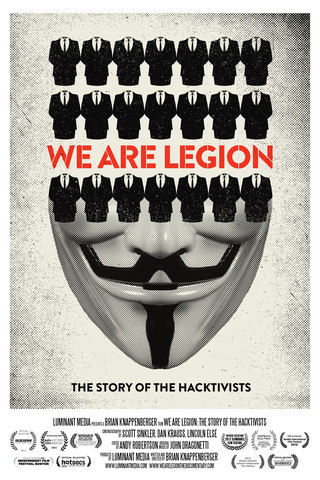
We Are Legion (2013)
Run Time: 93 min.
"Like cavemen discovering fire, the group quickly split between those who wanted to continue illuminating important issues (including Wikileaks and the Arab Spring) and those who just wanted to watch the world burn. The Guy Fawkes mask adopted by Anonymous members (who reject the idea of a single leader on principle) is meant to intimidate as much as protect; theirs is an increasingly rare spirit of revolt. "Expect us," they say, though the meaning of that warning remains in flux; the evolution toward a consistency of ideals has proved as tricky as Knappenberger makes it engrossing and essential to watch."
—Michelle Orange, The Village Voice
"Like cavemen discovering fire, the group quickly split between those who wanted to continue illuminating important issues (including Wikileaks and the Arab Spring) and those who just wanted to watch the world burn. The Guy Fawkes mask adopted by Anonymous members (who reject the idea of a single leader on principle) is meant to intimidate as much as protect; theirs is an increasingly rare spirit of revolt. "Expect us," they say, though the meaning of that warning remains in flux; the evolution toward a consistency of ideals has proved as tricky as Knappenberger makes it engrossing and essential to watch."
—Michelle Orange, The Village Voice
Subscribe to:
Posts (Atom)