Wednesday, March 12, 2014

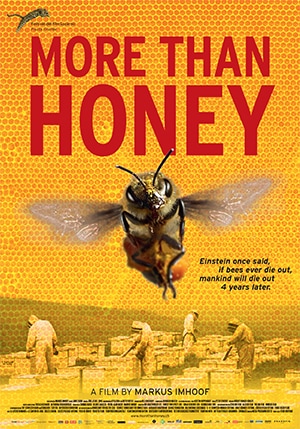
More Than Honey (2013)

Director:  Markus Imhoof
Run Time:  91 min.
Call Number: SF538.5.C65 M67 2012

"In recent years, bee-farming statistics have been frightening. For some yet undetermined reason bee-farming has been diminishing around the world as bees have been dying dreadfully, and now an Austrian film-maker, Markus Imhoof, also a bee-farmer, has made this picture—not as an attack on the danger but as a general illuminator. Bee farming has been around for 15,000 years, and a lot of notable minds—Einstein among them—have said that if bees were to disappear, human beings would disappear within four years. Imhoof makes bees more important than they have previously seemed."

Monday, March 10, 2014

War on Whistleblowers (2013)

Director: Robert Greenwald
Run Time: 66 min.
Call Number: JF1525.W45 W37 2013
 
"You don't have to be a rightwing wacko or naive lefty to be chilled by some policies and practices of the Obama administration. Nothing illustrates that better than the administration's treatment of whistleblowers who take on the federal government. Robert Greenwald's latest documentary focuses on the brutal fallout faced by four people—Michael DeKort, Thomas Drake, Franz Gayl, and Thomas Tamm—who exposed corruption in branches of the government or corporations working with the government. . . . Fast-moving and sleekly crafted, the film packages its dire warnings about the ways truth-speakers are penalized, and what that portends for the country, in a way that is accessible without sacrificing nuance or intelligence."
—Ernest Hardy, Village Voice

Wednesday, March 5, 2014

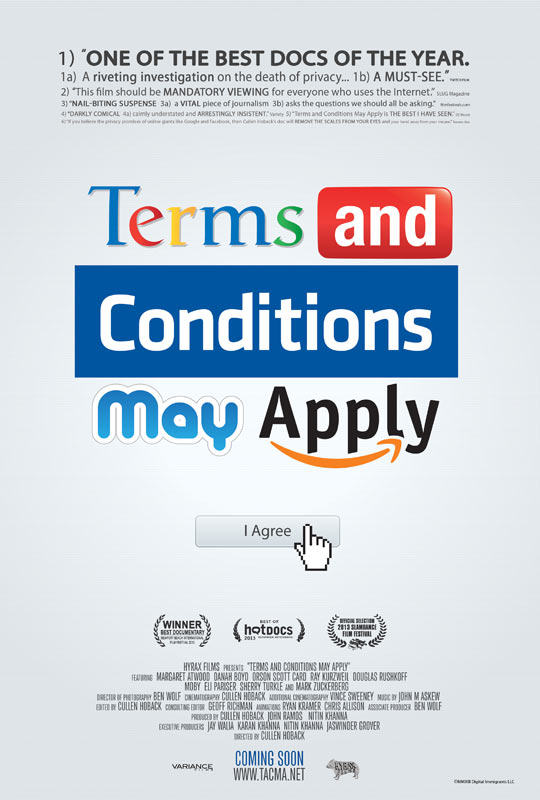
Terms and Conditions May Apply (2013)

Director: Cullen Hoback
Run Time: 80 min.
Call Number: KF1263.C65 T47 2013


The title of Terms and Conditions May Apply is unlikely to excite, but the content of this quietly blistering documentary should rile even the most passive viewer. . . . Investigating our casual surrender of privacy rights every time we click the 'Agree' button on those dense (and typically unread) online user contracts, the director Cullen Hoback outlines the real-life dangers of digital heedlessness. As the film illustrates, a random tweet or innocent Google search could summon a SWAT team to your door or transform you into a suspected terrorist. . . . Actual horror stories aside, this concise and lively summary of the many ways corporations, law enforcement and government agencies gather, share and use our information—assisted by digital giants like AT&T and Google—is creepily unnerving. 
—Jeannette Catsoulis, New York Times


Wednesday, February 26, 2014

The House I Live In (2013)

Director: Eugene Jarecki
Run Time: 108 min.
Call Number: HV825 .H68 2013


"Instead of peppering the audience with dull facts and figures, Jarecki uses people to illustrate his main thesis, which is that the American legal system has resorted to punishing drug offenders — even casual users — and permanently ruining their lives instead of trying to rehabilitate them. The war on drugs has become too lucrative an industry to rethink or reconsider. Entire towns depend on prisons for employment; the lack of opportunity for young people growing up in projects or slums practically ensures they will eventually resort to drug dealing, feeding the machine; ridiculously excessive sentences ensure there will always be a need for more jails (one man in the film is condemned to life without parole for carrying three grams of meth)."
—Rene Rodriguez, Miami Herald

Thursday, February 20, 2014

Nicky's Family (2013)

Director: Matej Mináč
Run Time: 96 min.

"Nicky’s Family is a Czech tribute (stirringly deserved) to Nicholas Winton, the Englishman who organized the rescue of mostly Jewish Czech children from Prague when the Nazis invaded. His organization has been active ever since in similar work. Welcome as this picture is, the tribute is only part of its achievement. It has created a cinematic marvel: a reproduction of Prague in 1939. . . . Most of us have seen plenty of film of Nazi devastation, but this film’s director, Matej Mináč, apparently felt that the available footage is not good enough; and so he and his Czech editors proceeded to recreate that crisis. By weaving originals and additions, the film creates the feeling of life in a territory where the Germans could pick up a section of the earth as if it were a blanket and toss it into disorder in the name of their order.
—Stephen Kauffman, The New Republic